Self Storage or Container Storage in Kilmarnock? How to Choose the Right Space
Search for self storage in Kilmarnock and you will see several formats described with similar language: storage rooms, units, lockers, containers and drive-up storage. That can make comparison harder than it should be. A low headline price is not useful if the door opening will not take your largest item, while a beautifully finished indoor room may be unnecessary if you mainly need to unload robust trade equipment from a van.
The best choice depends on what you are storing, how often you need it, how it will arrive, how long it will stay and what the provider actually includes. Container storage in Kilmarnock can be especially practical for direct vehicle loading and larger loads. Indoor self-storage rooms may suit people who want a wider range of smaller spaces or an internal loading environment. Neither format is automatically better for every customer.
This guide explains the questions that matter so households and businesses across Kilmarnock and Ayrshire can compare like with like. Storage Machine publicly describes its offer as container self storage in Kilmarnock and currently identifies a 20-foot container, but detailed dimensions, prices, access and security information are still awaiting confirmation. Treat the points below as a buying checklist and obtain the current site-specific answers before booking.
What does “self storage” mean?
Self storage is an arrangement in which you rent a defined space and manage the contents yourself, subject to the operator's terms. You normally pack, transport, load, organise and retrieve your own goods. The rented space might be a room inside a larger building, a purpose-built external unit or a steel container at a managed site.
That means “self storage” and “container storage” are not opposites. Container storage can be a type of self storage. The useful comparison is between the exact physical spaces and services being offered: indoor or outdoor access, drive-up or corridor access, unit size, door dimensions, environmental conditions, permitted goods and access arrangements.
Do not assume a feature from the category name. A container is not necessarily accessible around the clock; an indoor room is not necessarily climate controlled; and the word “secure” does not tell you which measures are in place. Ask for specific information.
What is container storage?
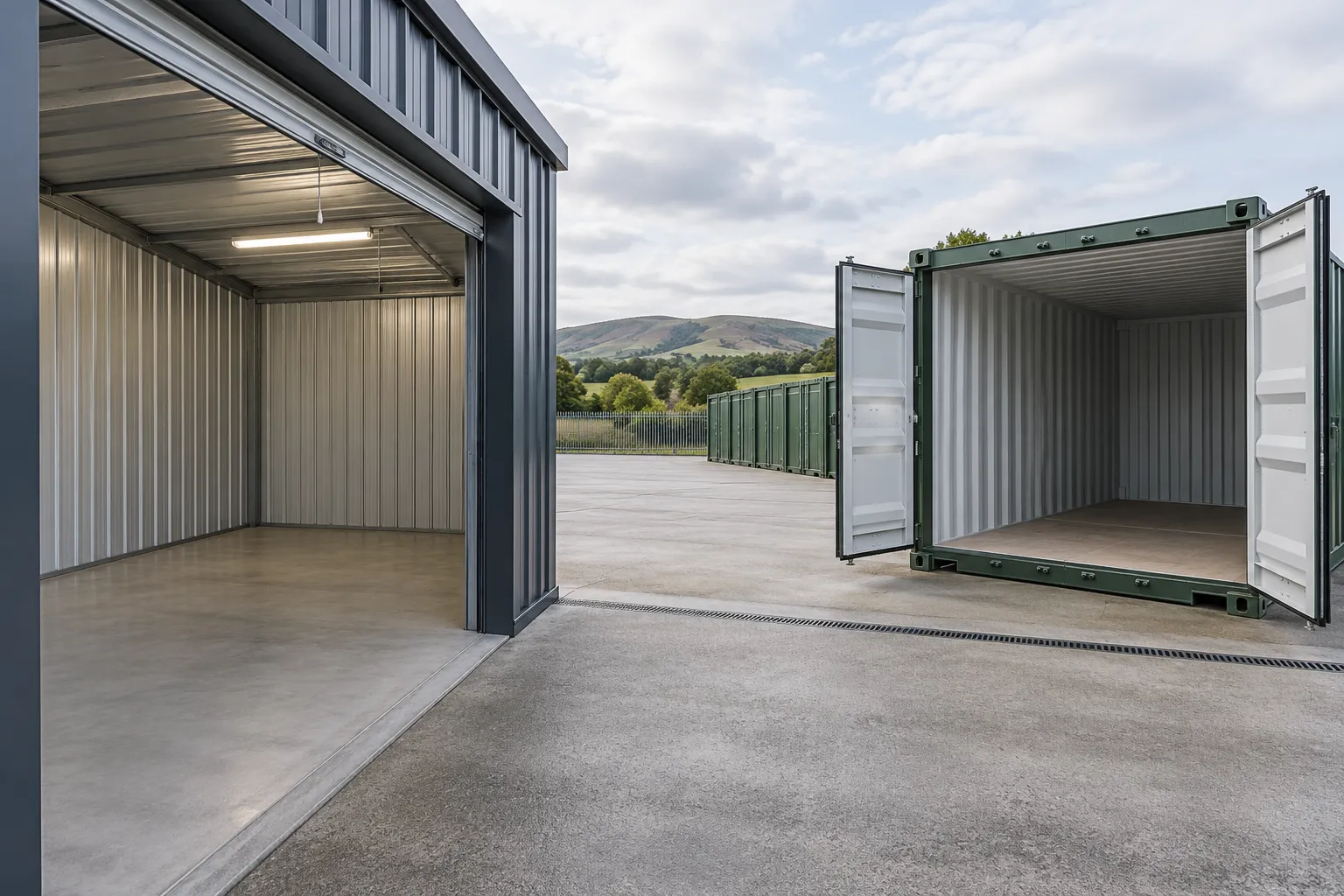
Container storage usually provides a steel container as the customer's individual storage space. At a drive-up site, a car or suitable van may be able to stop close to the doors, reducing the distance that furniture, tools, boxes or stock must be carried. This can be valuable during a whole-house move, a renovation or repeated business collections.
Containers are available in different specifications across the industry. Internal dimensions can be smaller than the familiar external length suggests, and the usable opening is narrower and lower than the external frame. Ventilation, lining, insulation, door seals, flooring and locking arrangements also vary. The only reliable basis for a decision is the provider's current specification for the actual container being offered.
Storage Machine's sizes page presently lists a 20-foot container without published internal measurements or door-opening dimensions. Measure the widest, tallest and longest item you intend to store, then ask for confirmed internal and opening measurements. Leave an allowance for handling; an item that theoretically matches the opening may still be difficult or unsafe to manoeuvre.
What is indoor self storage?
Indoor self storage typically divides a building into rooms or lockers reached through an entrance, corridor or loading area. A site may offer many sizes, including small rooms that suit a few boxes, student possessions or archives. Goods are sheltered during the journey from the building entrance to the room, although the loading bay and vehicle route still matter.
The trade-off can be extra handling. You may need to move belongings from the vehicle to a trolley, through doors or lifts and along corridors. Ask about lift dimensions, weight limits, corridor widths, thresholds and the distance from the unloading area. For a sofa, pallet, long worktop or heavy tool chest, the route may matter more than the nominal floor area.
Indoor does not automatically mean heated, humidity controlled or suitable for every sensitive item. Confirm the actual conditions and the operator's rules.
Start with five decision questions
Before comparing prices, answer these five questions:
What exactly will be stored, including the largest and most sensitive items?
How much space does the load need when packed safely rather than compressed unrealistically?
How will the goods arrive, and how far can you carry them?
How often will you need to retrieve something?
What conditions, insurance and legal duties apply to those goods?
Your answers create a storage brief. A household storing dry furniture for eight weeks has different needs from a tradesperson collecting tools every morning. An online retailer with frequently changing boxed stock needs a different layout from someone archiving records for a defined retention period.
Compare access from the road to the unit
Access is a sequence, not a single opening time. Consider the route from the public road to the site entrance, from the gate to the unloading point and from the vehicle to the stored goods.
For container storage in Kilmarnock, ask whether customers may drive directly to the container, what vehicle sizes are accepted, whether turning space is limited and how poor weather affects the loading area. If you expect a removals lorry or regular supplier delivery, confirm it rather than assuming that access suitable for a car will also suit a larger vehicle.
For an indoor facility, ask about parking, covered loading, trolleys, lifts, steps and door widths. A short level trolley route can be easier than nominal drive-up access on an awkward surface; equally, direct access to a container can save substantial handling when the load is bulky.
Check customer access hours separately from office or support hours. Find out what happens if a door or access credential fails, and whether another authorised person may enter on your behalf. The Storage Machine is at Moorfield Industrial Estate, Kilmarnock, with 24/7 customer access. Confirm the entrance and unloading arrangements before your first visit.
Match the space to the belongings
Robust, dry household goods can often be suitable for either format when they are packed correctly and accepted by the operator. These may include clean furniture, sealed boxes, dismantled beds, garden furniture that has been cleaned and dried, and non-hazardous household equipment.
Container storage can work well for a larger single load because the space is open and accessible through broad doors. It may suit a house move, staged renovation, bulky furniture or business equipment. The main discipline is creating a stable stack and an aisle rather than filling the front first and trapping everything behind it.
A small indoor room may be more proportionate when you have only a limited number of cartons or need a size smaller than a standard container. It may also be convenient when frequent access involves a few light items rather than van loads.
Sensitive belongings need individual assessment. Artwork, musical instruments, photographs, books, electronics, documents, soft furnishings and antiques can react to temperature, moisture, dust or poor packing. Ask the provider about the actual environment and talk to the item's manufacturer, conservator or insurer where appropriate. Do not describe any unit as climate controlled unless the operator confirms an active, defined system.
Think about moisture before the doors close
Many storage problems start with moisture introduced by the customer. A container or room cannot make a damp sofa, wet garden tool, freshly cleaned rug or partially defrosted freezer dry. Pack only clean, dry goods. Allow appliances and textiles time to dry fully, and avoid loading during heavy rain where belongings cannot be protected.
Use materials appropriate to the item and storage period. Breathable covers can be preferable for some furniture, while sealed plastic boxes may help protect suitable small goods from dust. Cardboard boxes should be strong and kept away from any surface where the operator advises a gap. Pallets or shelving may be useful only if permitted, safe and suitable for the unit.
Leave air space where the provider recommends it. Do not block vents, drill into walls or add electrical equipment. If you visit during the rental, look for unexpected condensation, odour, damp packaging or changes in the unit and report concerns promptly.
Ask what “secure” means at that site
Security should be described in concrete layers. Ask about the site boundary, entrance control, lighting, surveillance, recording or monitoring arrangements, individual door construction, locks, staff presence and incident procedures. Not every site will use every measure, and no measure removes all risk.
Find out who supplies the lock and which type is accepted. Ask how access is recorded, how lost keys or credentials are handled and whether contractors or family members can be authorised. For business storage, consider your own control over employee access as well.
Do not use a slogan as a substitute for details. Storage Machine uses trust and protection language in its brand, but its public FAQ currently leaves the specific security arrangements to be announced. Those details should be confirmed before an article or customer repeats claims about CCTV, gates, alarms or monitoring.
Compare the full cost, not just rent
Create a simple comparison sheet for each option. Record:
The amount due before move-in.
Recurring rental and billing interval.
Whether the displayed amount includes VAT where applicable.
Deposit and refund conditions.
Minimum rental period and notice requirements.
Lock purchase or hire.
Insurance or protection requirements.
Access, administration or late-payment charges.
Any introductory price and the later standard price.
Transport, van hire and labour.
The cost of extra journeys caused by location or access.
A larger unit with easier loading may reduce labour and van time, while a smaller room may avoid paying for unused space. The cheapest rent can become the higher overall cost if the facility requires repeated long journeys or awkward handling. Compare the likely total for the whole rental period, including a realistic delay.
Storage Machine has not yet published its price, billing period, VAT treatment, deposit or compulsory charges. These points must be confirmed before making a price comparison or publishing promotional wording.
When container storage may be the stronger fit
Container storage in Kilmarnock may deserve priority on your shortlist when:
You have a substantial load of furniture, boxes, equipment or stock.
Direct or near-direct van access would reduce handling.
You expect to add or remove bulky items.
Your goods are suitable for the confirmed container environment.
A standard available container size matches the load and budget.
The site route, hours and rules suit your vehicle and schedule.
It can also be useful for trades and small businesses holding suitable tools, materials, packaging or boxed stock. The unit should be organised as storage, not assumed to be a workshop or customer-facing premises. Confirm whether deliveries, shelving, charging equipment, working inside the unit or daily commercial access are permitted.
When a smaller indoor room may be the stronger fit
An indoor self-storage room may be worth comparing when:
You have only a small quantity and can choose a closely matched room size.
The indoor route is level, short and suitable for your items.
You retrieve a few boxes frequently.
The confirmed indoor conditions suit sensitive contents better.
Covered loading materially helps your move.
You prefer a facility with a broad range of room sizes.
The final decision still depends on the actual site. “Indoor” is not a guarantee of climate, easy access or higher security, just as “container” is not a guarantee of drive-up access or a particular condition.
Household examples
Imagine a family renovating a Kilmarnock home. They need to remove a sofa, dining set, wardrobes and forty boxes for three months. A drive-up container could reduce carrying and keep the whole load together, provided the measurements, environment, price and access are suitable. Their layout should put furniture and low-priority boxes at the back, with decorating supplies that are permitted and needed later close to the door. Paints, fuels and other hazardous products may be prohibited and require another arrangement. Our guide to renovation storage in Kilmarnock covers planning, packing and timing for a project like this.
Now imagine someone in Fenwick storing twelve boxes while preparing a spare room. A smaller indoor room elsewhere might be more economical if one is available, while a Kilmarnock container could provide more space than needed. Travel frequency and minimum rental cost may decide the comparison. Storage Machine does not currently claim a Fenwick location, so a Fenwick searcher should assess the real journey to the confirmed Kilmarnock site.
Business examples
A Kilmarnock tradesperson may value quick loading of robust, permitted tools and boxed consumables. Container storage could work well if vehicle access aligns with the working day and the operator permits the intended items. The business still needs an inventory, controlled keys and appropriate insurance. Fuels, gas cylinders, flammable products and other dangerous substances require specific lawful arrangements and should never be placed in general storage without written confirmation.
An Ayrshire professional practice archiving paper records may care more about document security, retrieval logs, retention schedules and environmental conditions. The smallest cheap unit is not automatically appropriate. Physical records containing personal data must remain controlled and protected, including while transported off site. A specialist records service or additional locked cabinets may be more suitable, depending on risk and the storage terms.
Inspect before you rely on the space
Where possible, inspect the exact format or a representative unit. Look at the door, seals, floor, walls, roof, vents and general condition. Check for visible water entry, damage, strong odours, pest evidence or obstacles. Walk the complete unloading route with your largest item in mind.
Ask the operator to show where customers may park, turn and load. Confirm the lock, access process and contact route for problems. Read the agreement, prohibited-items rules and insurance requirements before paying. If you are unsure what cover you need, our guide to storage insurance explained walks through home contents cover, specialist policies and valuing your belongings. Keep a copy of the terms that applied when you moved in.
A simple decision scorecard
Score each option from one to five for these factors: usable size; door and route; travel time; access hours; handling effort; environmental suitability; confirmed security; full cost; contract flexibility; and customer support. Give extra weight to the factors that could make the space unusable. A door that is too narrow cannot be offset by a lower price.
Then test the leading choice with three questions. Can every item legally and physically enter? Can you reach the things you will need? Can you afford the likely total if the rental lasts longer than planned? If any answer is uncertain, resolve it before booking.
Self storage in Kilmarnock should make space simpler. The right option is the one whose confirmed features fit your belongings, vehicle, schedule and budget. For many larger household and business loads, container storage in Kilmarnock offers a practical format. For smaller or more sensitive loads, another form of self storage may warrant comparison. In every case, specifics beat labels.
To discuss Storage Machine's current container availability, send a rough inventory, the dimensions of your largest item, your preferred move-in date and the vehicle you expect to use. An enquiry does not reserve a unit, so obtain confirmation before committing to removals or delivery arrangements.
Storage overview: container self storage options
Storage sizes and prices: current container size and pricing information
Household storage: household storage in Kilmarnock
Business storage: storage for trades and local businesses
FAQs: read the storage FAQs
Contact: ask about current availability
Comparing self storage and container storage in Kilmarnock? Tell Storage Machine what you plan to store, your largest item dimensions, preferred date and expected vehicle so the team can confirm the current specification, terms and availability. An enquiry does not reserve a unit.